Crossfunction: conversion and holiness
Showing posts with label conversion and holiness. Show all posts

Sunday, November 06, 2011

Would Jesus defend the Catholic Church?

Another challenging email!

John,

I have written to many writers about some of these questions. Some of them blow them off as if age helps to mitigate the substantialness of them. So I 'll ask you, as you genuinely seem interested and convinced.

At some point don't we have to ask ourselves hard questions such as "Could it be possible that our Church is not Good?" When so much of it's history has been clouded with scandal, and has been responsible for so much hurt and pain, don't we at some point have to ask ourselves if Jesus himself would defend it? I find it hard to believe that any thinking Catholic could honestly say that Jesus would defend the Catholic Church and all her sins. Jesus after all was a Jew, and criticized His own religion for her wrongs. Why would the label "Catholic" make him think any differently? It wouldn't.

Wouldn't Jesus just want us to move forward, leaving our imperfect ideas of what a Church should be behind and working together to create a new reality which He intended? You and so many others like you get so stuck on defending "Catholicism" that you forget what Jesus was all about. Put your "catholicism" aside and talk to Jesus. He is a great and wonderful spirit who came here to show us that right is more important than allegiance. Follow His lead.

Let me ask you one important question. If Jesus came to you and said "The Catholic Church is wrong. Do not follow it's teachings. Simply follow Me and My Word." and then the Catholic Church told you "Do not believe Jesus, He is wrong. God has established us as the vehicle of truth. Do as we say." Who would you believe? Would you act against the dictates of your Catholic Church to follow Jesus? What would you do? Well now you need to change the question. What WILL you do.
My reply...
Dear L,
Thanks a lot for writing. Your question is very similar to one I received just yesterday, so I refer You to my answer to 'C' in the previous blog entry. But I'd like to also add a few thoughts here...

You seem to focus on the sins in the history of the Catholic Church. What about the sins in the history of the numerous Protestant churches? I don't know of any Christian churches that have members without sin. Does Jesus condemn every church that has sinful members? Doesn't the Bible teach that the Church will be a home for redeemed sinners struggling to live by faith, sometimes falling into sin, and then repenting and beginning again? God is a Father seeking to heal sinners, and He works through sinners to do so.

You asked what would I do if Jesus came to me and said that "the Catholic Church is wrong". Well, honestly, He hasn't said that to me, and You can't expect that I will accept Your letter as the voice of God. You didn't even do me the courtesy of introducing Your name or the name of Your church. If You are serious about the truth, and about this discussion, I would like to know Your name and Your church, and then I would be very interested in discussing our beliefs in the light of Scripture.

I'd rather we be friends in Christ, not adversaries!

God bless You,

John Robin.

The Catholic Church's "big lie"

I just received a challenging email:

Dear John.
Allow me to express my thoughts about the Catholic Church's claim to be the one founded by Jesus Christ.  I would say, it is a big lie.  If it is the one founded by Jesus Christ, then why so many of them (priests, bishops, cardinals) from the middle ages to now did not live their lives according to Jesus Christ's teachings or of the lives of the Apostles. I don't have to mention the details because its very obvious. Just look around. I don't need to cite scriptures to to prove what l am saying because its very obvious. Thank you. God bless.
C-
Here's my reply...
Hi, C,
Thank You for writing to me with Your question. It’s a very good question and I’ll try to provide some answer.

It seems to me that essentially You are asking why there are sinners in the Church. You are implying that if Jesus founded a church, its members would be holy; they would live according to Jesus Christ’s teachings; they would not sin. And if we find a church whose history has many examples among its members and leaders who sinned badly, certainly that is evidence that this church was not founded by Jesus. Right?

Well, no, actually. Look at the first apostles. James, John –and their mother- wanted special places of honor above the others in Jesus’ kingdom (Matthew 20:21). Peter denied Jesus three times. Judas stole money from Jesus and the others, and later betrayed Jesus. At Jesus’ arrest all the apostles (except John) ran away. Peter acted hypocritically toward the Jews and gentiles and received the rebuke of Paul. You can be sure there were many other sad failings among the apostles and other disciples that were not recorded in the Gospels. And the other New Testament writings are full of evidence that the early Christians were sinners who struggled with divisions, factions, controversies, and scandals. Not just among the apostles and priests, but among the lay members as well. Are these facts proof that Jesus did not found a Church, or that His Church was ruined by sin? Did Jesus' plan to build a Church ultimately fail?

No. To think so is to misunderstand the Church Jesus founded. The Church has the Son of God as its head and cornerstone, but very human apostles as its foundation. Its walls are built of living stones which are very much redeemed sinners still struggling to imitate Christ despite many failings. It has the Holy Spirit to guide its members on their path through life, but has human members who have not lost their ability to sin. Christ is the vine, and we are the branches, but we branches have the ability to choose to do God’s will, or to turn away and prefer our own will.

You mention the sinfulness of bishops and cardinals. But what about Your own sinfulness, and mine? Has Your life been blameless? Mine has not.

C, if You believe that “true” Christians don’t sin, then You don’t know Your Bible any better than You know human nature. If You believe there is a church –perhaps Your own- that has as its leaders and members people who never sin, then I will use Your own words: “it is a big lie”. The possibility of sin will not be completely erased from the lives of the saved until all the saved have been gathered into Heaven.

Until then we remain at war. The Holy Spirit equips us to do battle against temptations to turn away from the will of God. With God’s help it is very possible to resist sin, and to grow stronger so that we can live more and more holy lives. But in this life we always have the possibility of rejecting God, and Christians sometimes fall into sin. When we see a fellow believer stumble and fall into sin, it is a terrible thing… just as when it happens in our own lives. But it does not mean that we are not believers, or that we are not members of Jesus’ Church.

C, the Church is like a hospital, a hospital for sinners. The hospital does not kick out patients (or the doctors) because they are sick, or because they fall ill more than once. The fact that they are sick does not prove that the hospital is not a hospital.

So, C my friend, I say to You that You are using the wrong measuring stick to identify the Church. You won’t find the Church Jesus founded by searching for a church with no sinners. You will find it by asking God to help You find it, and then by studying what the Bible teaches about the Church. There are several simple things the Bible clearly teaches about the Church:
1) It is One. Jesus found a Church, and He didn’t found two, three, or ten thousand of them. He founded one.
2) It is holy. It contains everything that we need to grow in holiness: holy teachings; the holy sacraments; holy fellowship; the example of countless thousands of saints –a “great cloud of witnesses”- whose lives reflect the light of Christ and inspire us to imitate Him. It not only helps people become holy, it in fact does produce many people who achieve great holiness.
3) It is “catholic”, meaning universal. It is a church for the whole world, for all peoples and times. It is a reflection and foretaste of Heaven, where all Christ’s followers are united in one faith, one Lord, one baptism.
4) It is apostolic. It was founded upon apostles personally selected by Jesus, and who had the authority to pick other men to share that role with them and after them. For the past twenty centuries that apostolic authority has continued among those who have received it from the apostles and their successors. Nothing in the Bible indicates that this apostolic foundation was ever to be abandoned.

The Catholic Church has the four key characteristics. Does Yours?

Finally, I think it's dangerous to pass judgement on the hearts of other persons, especially Christians who lived many centuries ago. People we might be tempted to think were really big sinners might have lived lives more pleasing to God than our own. Humility and a healthy respect for God's justice should make us guard against passing negative judgement on others.

C, I would love to hear Your thoughts about these important things!

Thank You again for writing to me.

God bless You,

John Robin.

Thursday, April 23, 2009

Why should I confess my sins to a priest?

Answer coming soon!

Well, if someone asks me for an answer, I'll try to provide one soon.

Wednesday, March 04, 2009

Saved by another's faith?

3:1 Then the word of the LORD came to Jonah the second time, saying,
3:2 "Arise, go to Nin'eveh, that great city, and proclaim to it the message that I tell you."
3:3 So Jonah arose and went to Nin'eveh, according to the word of the LORD. Now Nin'eveh was an exceedingly great city, three days' journey in breadth.
3:4 Jonah began to go into the city, going a day's journey. And he cried, "Yet forty days, and Nin'eveh shall be overthrown!"
3:5 And the people of Nin'eveh believed God; they proclaimed a fast, and put on sackcloth, from the greatest of them to the least of them.
3:6 Then tidings reached the king of Nin'eveh, and he arose from his throne, removed his robe, and covered himself with sackcloth, and sat in ashes.
3:7 And he made proclamation and published through Nin'eveh, "By the decree of the king and his nobles: Let neither man nor beast, herd nor flock, taste anything; let them not feed, or drink water,
3:8 but let man and beast be covered with sackcloth, and let them cry mightily to God; yea, let every one turn from his evil way and from the violence which is in his hands.
3:9 Who knows, God may yet repent and turn from his fierce anger, so that we perish not?"
3:10 When God saw what they did, how they turned from their evil way, God repented of the evil which he had said he would do to them; and he did not do it.
-Jonah 3:1-10 RSV

"...from the greatest of them to the least of them...(v. 5)"

Even the infants believed God, proclaimed a fast, and put on the sackcloth? The passage states the entire city, without exception, believed and repented. If children too young to understand what was happening were included in this -and they were- then this means that they were not excluded from the benefits of their families' faith and repentance. They were saved from destruction because of their parents' acts of faith. Later, as they would grow up, God would require them to exercise faith of their own.

Much as in Baptism.

Friday, January 16, 2009

Living the "obedience of faith"

"1 Let us fear therefore lest the promise being left of entering into his rest, any of you should be thought to be wanting.
2 For unto us also it hath been declared, in like manner as unto them. But the word of hearing did not profit them, not being mixed with faith of those things they heard.
3 For we, who have believed, shall enter into rest; as he said: As I have sworn in my wrath; If they shall enter into my rest; and this indeed when the works from the foundation of the world were finished.
4 For in a certain place he spoke of the seventh day thus: And God rested the seventh day from all his works.
5 And in this place again: If they shall enter into my rest.
6 Seeing then it remaineth that some are to enter into it, and they, to whom it was first preached, did not enter because of unbelief:
7 Again he limiteth a certain day, saying in David, To day, after so long a time, as it is above said: To day if you shall hear his voice, harden not your hearts.
8 For if Jesus had given them rest, he would never have afterwards spoken of another day.
9 There remaineth therefore a day of rest for the people of God.
10 For he that is entered into his rest, the same also hath rested from his works, as God did from his.
11 Let us hasten therefore to enter into that rest; lest any man fall into the same example of unbelief."
-Hebrews 4:1-11 RSV

The author of Hebrews says that the Israelites did not reach the "place of rest" because they failed to have faith in the divine message delivered through God's messengers. He stresses that God's work was not lacking, that it was completed and therefore God rested on the seventh day. Likewise, we are cautioned to do everything necessary to be obedient to all that the gift of faith demands. Else we may find that we, like the Israelites who wandered the desert of disobedience, may disqualify ourselves from the promised land.

God's work of redemption is complete. But receiving this gift and remaining heir to its promise until the inheritance is at hand requires more than an initial and verbal "Yes". Faith is a gift that demands that we put into practice whatever God asks of us. That we believe with our minds and hearts, and put that belief into concrete practice with our will and body: that when we fail this, we repent and begin again and again, and persevere in this divine sonship until the end.

It is only this path that assures us of entering into the land that God has prepared for those who love Him.

Wednesday, August 29, 2007

Preaching Christ crucified

A Christian friend who describes himself as "non-denominational" mentioned that Protestant churches usually display a cross, not a crucifix, and that some Protestants "have a problem" with Catholic churches displaying a crucifix. 'After all, Jesus isn't on the cross any more, is He? He rose from the dead. That's the whole point, isn't it?'

Now wait just a second. How does a crucifix -a cross with an image of Christ crucified- deny the resurrection? A crucifix doesn't deny the resurrection any more than a bare cross denies the crucifixion. Clearly neither is the case. So why do some Protestants object to a crucifix, which preaches visually what words often struggle to express about the depth of Christ's love? I'm at a loss to find a good reason to object to an image of Jesus dying for my sins.

Saint Paul didn't seem to think it inappropriate to point to the historical event of the crucifixion as a central reality of the faith. In his words,

"we preach Christ crucified, a stumbling block to Jews and folly to Gentiles, but to those who are called, both Jews and Greeks, Christ the power of God and the wisdom of God."
-1 Corinthians 1:23-24 RSV

Paul acknowledges that "Christ crucified" is indeed a cause for offense, but not among "those who are called", not among those willing to accept "the power of God and the wisdom of God" on God's terms.


During that same conversation, my friend expressed reservations about the idea that God may use created objects as instruments of transmitting grace. Take for example, the woman who was healed of a hemorrhage upon touching Jesus' cloak. Or, those who were healed upon contact with Paul's handkerchief or Peter's shadow. Or Naaman's healing from leprosy upon bathing in the Jordan -despite his complaints about having to submit to such a ritual (cf. 2 Kings 5). Don't these incidents suggest the participants were swayed by superstition, wrongly attaching spiritual significance to material objects? Don't such things take our eyes away from God and toward created things?

Come on. If this is the case then the cross of Christ is a distraction that takes our eyes off Christ, and Christian churches should refuse to display crosses. But Saint Paul wrote,

"...far be it from me to glory except in the cross of our Lord Jesus Christ, by which the world has been crucified to me, and I to the world."
-Galatians 6:14 RSV

It is not wrong to glory "in the cross of our Lord", for God made the cross to be an instrument of our salvation. Drawing near the cross we draw near Christ,

"...and he who does not take his cross and follow me is not worthy of me."
-Matthew 10:38 RSV


Jesus did not despise the lowliness of His wooden cross, this key instrument of our salvation. He could have saved us without the cross, but in the wisdom of God even the lowliest and most despised elements of creation take on huge importance in the economy of salvation. In His desire to unite us to Himself, He not only condescends to man, but teaches man to condescend to receive help through the vessels He has chosen. This truth reflects the humility and glory of our Savior:

Jesus said to them, "Have you never read in the scriptures: 'The very stone which the builders rejected has become the head of the corner; this was the Lord's doing, and it is marvelous in our eyes'?"
-Matthew 21:42 RSV

Does Paul confuse Christ with the cross, or attribute the power of God to the cross itself? Of course not. But nor does he fail to recognize that God has incorporated into His plan of salvation the material universe which He Himself created. He has used and continues to use created things as instruments of salvation, conduits of grace, and vessels of honor. This is what He made them for! And this is how we should regard them... and use them.

Similarly, people whose faith was great enough to recognize God's eagerness to involve His own creatures in the salvation of the world overcame any pride or hesitation they may have felt, and reached out for contact with that cloak or handkerchief, that shadow, or that river... and through these things encountered the divine. And thousands were healed both in spirit and flesh.

Sunday, February 25, 2007

1 Peter 4: Following Christ means suffering with Christ

1 PETER CHAPTER 4


Revised Standard Version my paraphrase
1 Christ therefore having suffered in the flesh, be you also armed with the same thought: for he that hath suffered in the flesh, hath ceased from sins:
2 That now he may live the rest of his time in the flesh , not after the desires of men, but according to the will of God.
1 Just as Christ willingly suffered in the flesh, You should expect to imitate His suffering. For he who has willingly endured suffering has turned from sin,
2 so that he may live the rest of his life not according to the will of men, but of God.
3 For the time past is sufficient to have fulfilled the will of the Gentiles, for them who have walked in riotousness, lusts, excess of wine, revellings, banquetings, and unlawful worshipping of idols.
4 Wherein they think it strange, that you run not with them into the same confusion of riotousness, speaking evil of you.
5 Who shall render account to him, who is ready to judge the living and the dead.
3 You have had enough of living according to the will of the Gentiles, of them who have lived wild, drunken lives of impurity and idolatry.
4 Yet they condemn You, for You no longer live as they do.
5 But in the end they too must render an account to Him who shall judge both the living and the dead.
6 For, for this cause was the gospel preached also to the dead: that they might be judged indeed according to men, in the flesh; but may live according to God, in the Spirit.
7 But the end of all is at hand. Be prudent therefore, and watch in prayers.
6 This is why the gospel was preached also to the dead: that they –like all men– may be judged in the flesh according to the gospel: yet by God’s will may attain eternal life in the Spirit.
7 But final judgment is imminent for all. Be wise, therefore, and remain watchful in prayer.
8 But before all things have a constant mutual charity among yourselves: for charity covereth a multitude of sins.
9 Using hospitality one towards another, without murmuring,
10 As every man hath received grace, ministering the same one to another: as good stewards of the manifold grace of God.
11 If any man speak, let him speak, as the words of God. If any man minister, let him do it, as of the power, which God administereth: that in all things God may be honoured through Jesus Christ: to whom is glory and empire for ever and ever. Amen.
8 First of all, You must love one another, for love repairs a multitude of sins.
9 Be hospitable toward each other, without complaint.
Serve each other as faithful stewards of the abundant grace You have received from God.
10 If any man will speak, let it be according to the words of God.
11 If any man serve, let him do so according to the power of God: so that in everything God may be honored through Jesus Christ: to Whom belongs all glory and dominion for ever and ever. Amen.
12 Dearly beloved, think not strange the burning heat which is to try you, as if some new thing happened to you;
13 But if you partake of the sufferings of Christ, rejoice that when his glory shall be revealed, you may also be glad with exceeding joy.
14 If you be reproached for the name of Christ, you shall be blessed: for that which is of the honour, glory, and power of God, and that which is his Spirit, resteth upon you.
15 But let none of you suffer as a murderer, or a thief, or a railer, or a coveter of other men's things.
16 But if as a Christian, let him not be ashamed, but let him glorify God in that name.
17 For the time is, that judgment should begin at the house of God. And if first at us, what shall be the end of them that believe not the gospel of God?
18 And if the just man shall scarcely be saved, where shall the ungodly and the sinner appear?
19 Wherefore let them also that suffer according to the will of God, commend their souls in good deeds to the faithful Creator.
12 Beloved, don’t be surprised at the fiery trial which You will undergo, as if this were unexpected.
13 If You willingly share in the sufferings of Christ, You also will share in great joy when His glory is revealed.
14 If You are reproached for the name of Christ, You will be blessed, because the power and Spirit of God rest upon You.
15 Let Your sufferings be those of Christ, not those of a murderer, thief, or coveter.
16 So do not be ashamed to suffer for being a Christian; rather, glorify God in the name of Christ.
17 For it is fitting that judgment begin within the house of God. And if we believers are already facing judgment first, what shall be the verdict against those who reject the gospel of God?
18 If the just man shall barely be saved, what lies in store for those who reject God and persist in sin?
19 So, those who willingly accept sufferings from God’s hand, should with good works entrust their souls to their faithful Creator.

Thursday, August 25, 2005

1 Corinthians 3: Saved -but only as through fire.

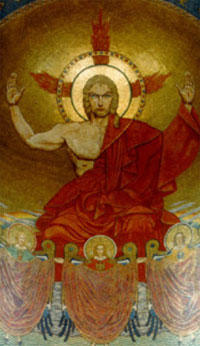
Christ in Majesty, mosaic, Shrine of the Immaculate Conception, Washington, D.C.

1 Corinthians Chapter 3 (RSV)


1 But I, brethren, could not address you as spiritual men, but as men of the flesh, as babes in Christ. 2 I fed you with milk, not solid food; for you were not ready for it; and even yet you are not ready, 3 for you are still of the flesh. For while there is jealousy and strife among you, are you not of the flesh, and behaving like ordinary men? 4 For when one says, "I belong to Paul," and another, "I belong to Apol'los," are you not merely men?

5 What then is Apol'los? What is Paul? Servants through whom you believed, as the Lord assigned to each. 6 I planted, Apol'los watered, but God gave the growth. 7 So neither he who plants nor he who waters is anything, but only God who gives the growth. 8 He who plants and he who waters are equal, and each shall receive his wages according to his labor. 9 For we are God's fellow workers; you are God's field, God's building. 10 According to the grace of God given to me, like a skilled master builder I laid a foundation, and another man is building upon it. Let each man take care how he builds upon it.

11 For no other foundation can any one lay than that which is laid, which is Jesus Christ. 12 Now if any one builds on the foundation with gold, silver, precious stones, wood, hay, straw-- 13 each man's work will become manifest; for the Day will disclose it, because it will be revealed with fire, and the fire will test what sort of work each one has done. 14 If the work which any man has built on the foundation survives, he will receive a reward. 15 If any man's work is burned up, he will suffer loss, though he himself will be saved, but only as through fire.

16 Do you not know that you are God's temple and that God's Spirit dwells in you? 17 If any one destroys God's temple, God will destroy him. For God's temple is holy, and that temple you are.

18 Let no one deceive himself. If any one among you thinks that he is wise in this age, let him become a fool that he may become wise. 19 For the wisdom of this world is folly with God. For it is written, "He catches the wise in their craftiness," 20 and again, "The Lord knows that the thoughts of the wise are futile."

21 So let no one boast of men. For all things are yours, 22 whether Paul or Apol'los or Cephas or the world or life or death or the present or the future, all are yours; 23 and you are Christ's; and Christ is God's.


Paul again with humility affirms his position as a servant of God, but one having the authority to teach definitively. He warns against building upon any foundation but that which he and the other apostles have laid by the grace of God.

He addresses Christians and reminds us that our works shall be judged. We shall enjoy reward or suffer loss, depending upon the outcome of that judgement. He does not refer to loss of salvation in this context, but rather addresses those of us who are ultimately saved. In this context "loss" refers to the suffering associated with the consuming fire's purification of us from those works we performed which were not worthy of Christ, and of which we had not fully repented.

In other words, all Christians indeed will face judgement following death. Even those who are to be finally saved will be held accountable for their works, which follow them through death to a most just judgement. Those works which were sinful or otherwise not worthy of Christ will be purged from us by a consuming fire. We ourselves shall not be destroyed by this fire, but rather shall pass through it as a final purification.

This purification is necessary because, as Paul reminds us, "God's temple is holy, and that temple you are." As the apostle John testifies, "nothing unclean shall enter [heaven]" (Revelation 21:27 RSV). If before death we have not completely turned away from sin and renounced all attachment to sin and sinful desires; if we have not permitted God's grace to thoroughly complete our sanctification before death, then upon death we shall not yet be fit to enter heaven. We must first face this Day of the Lord and His revealing fire. These flames shall complete the purification that we failed to complete prior to death.

This purifying fire is a sobering reality, but is a proof of God's love and mercy. For it is through this fire that our heavenly Father will perfectly complete the work of sanctification which He began in us. Is it a second chance at salvation? No, for those who do die outside of God's friendship will never enter heaven, and will only suffer the eternal fires of hell.

Only those who die in God's friendship shall be saved, and it is only these who may undergo this purification. All of these shall enter heaven.

Is this final purification a reason to be lax about our sanctification in this life? Certainly not! Jesus commands us:
"You, therefore, must be perfect, as your heavenly Father is perfect." (Matthew 5:48 RSV)


God hates sin and requires us to do everything in our power to repent of it and live holy lives. By grace this is possible. Yet we know that Christians still struggle with sin. Who among us would claim to have already reached the perfection of holiness that Jesus demands and which is a prerequisite of all who wish to enter heaven?

Thank God that His mercy extends even beyond the point of death, and He is able to complete the purification that He began within us, and which we cooperated with: provided we persevere to the end in His grace.