Crossfunction

Thursday, July 08, 2010

Getting it right

Hi, Ian!

You wrote,

hi John,
Sorry for the delay in getting back to you. I'm not a student of theology and am not able to interpret why you feel that what is written here is evidence of apostolic authority. This directive seems kind of harsh and the date suggests it is the word of men

The Creed of the Council of Toledo, A.D. 400, 447: (14)
"The rule of the Catholic faith against all heresies...
12. If anyone either believes that any scriptures, except those which the Catholic Church has received, ought to be held in authority or venerates them, let him be anathema."


We all believe in the same new testament and it changed everything, so why then is there this strife, why does the Holy Spirit dwell in people of all denominations, how does someone like Heidi Baker do miracles, by the glory of God which is working though her. Her ministry is non-denominational. I suggest that it's not what church you go to, that's not it at all, but how you well you follow Jesus's instructions about humbling yourself etc..so that Christ dwells in you, Ep 3:17 I started my walk with God just over a year ago and am a bit disappointed that more believer's aren't tuned into what God says we can do, Mark 16 : 17 & 18 or John 14: 13 & 14 according to the word, we should really be able to make a big difference. We need more of the kind of teaching about what we can do if we get it right [emphasis added]

-Ian K., letter of June 24, 2010 (reprinted with permission)

Ian, congratulations to You for just recently starting to walk with God!  That's wonderful and exciting, and with God's grace You'll continue to grow in faith, hope and love, persevering to the end. 

You're right to say that the Holy Spirit moves in the hearts of Christians in many denominations. But there's more to it.  If we want to gain everything the Spirit has to offer, we need to cooperate.  If God offers us many of His gifts through the ministry of the Church He founded, can we expect to receive them all if we are not united to His Church? You can't be truly united to Jesus without being united to His Church. Pride might try to seduce us into doing it all on our own, but don't be fooled! Jesus knew what He was doing when He founded His Church, and it's for our blessing.

If You had to go on a dangerous combat mission You would want to be trained, equipped, and accompanied by the best military officers.  You'd want to survive Your mission.  You'd want to have every possible advantage, and You'd want to get it right.

The Christian life is no less important!  It's dangerous because we still have defects and easily fall into sin.  Living by faith does not mean "winging it" without the many helps the Holy Spirit provides through the Church.  Does God provide graces and assistance to Christians who belong to many denominations?  Certainly.  But does He provide ALL His assistance in this manner?  No.

Living by faith is both a spiritual and a practical matter.  We must trust God, but we must trust Him enough to do what He says and unite ourselves to His Church.  There we find the 'big guns' of the spiritual life: the Sacraments which Jesus instituted, fellowship, apostolic teaching, and many other blessings too.  It simply makes sense to equip ourselves with the best that God offers us. It's not enough just to do good works. We need to be securely founded on the truth which Jesus entrusted to the apostles.

This is how we can really get it right.


Now, a response to Your quotation from the Council of Toledo... You raise two objections against it.

  • First: You say it sounds "harsh", but I say it's merely an uncompromising statement about which writings belong in the Bible. It's very similar to Paul's statement to the Galatians to safeguard the preaching they had received from apostolic sources:

    "But even if we, or an angel from heaven, should preach to you a gospel contrary to that which we preached to you, let him be accursed."
    Galatians 1:8 RSV

    Is Paul's statement harsh? Perhaps. But we should be more concerned with whether it's true, and whether it applies to us. There are lots of statements in Scripture which may seem a little harsh. The apostles sometimes used pretty tough talk, and Christians today probably need a bit of that, just like in the first century. Shouldn't the Church proclaim the truth with whatever words best fit the situation?
  • Second: You imply that since the Creed of the Council of Toledo occurred in the fifth century A.D. that therefore its teachings are "the word of men".

    I dealt with this issue in my previous letter, and I don't want to waste Your time by repeating my explanation in detail. But in a nutshell, Scripture teaches clearly that the apostles' legitimate successors today have the same authority to teach that the apostles had in the first century. When they do so they are not teaching the "words of men" but the Gospel of Jesus Christ. If we reject them we reject Christ.

You said You're "not a student of theology", and didn't respond to my biblical defense of the importance of the Church. But You're a Christian now, and Christians have to be committed to following the Gospel truth wherever it leads. Call it theology if You want, but it's really just the Good News of Jesus Christ.  And Scripture shows that if we want the fullness of that Gospel truth, our best option is faithful unity with the apostles and their successors.  

"So then, brethren, stand firm and hold to the traditions which you were taught by us, either by word of mouth or by letter."
2 Thessalonians 2:15 RSV

Arguing that we don't need the apostles or Church -"the pillar and bulwark of the truth" (1 Timothy 3:15)- is like telling God that we don't need exactly what He has revealed we do need.

The truth about this is too important to gloss over. As a Christian You have a right to know the truth, and a duty to respond to it.

Ian, good talking with You! I hope You'll write back with Your thoughts.

Cheers,
John Robin.

Monday, June 14, 2010

Talking to "dead" people?

Praying to saints in Heaven: Does the Bible support asking saints in Heaven for their help?


"He is not God of the dead, but of the living..."
Mark 12:26


What does it mean to “pray”?

1. To utter or address a prayer or prayers to God, a god, or another object of worship.
2. To make a fervent request or entreaty.
http://dictionary.reference.com/search?q=pray

Is prayer effective?


…pray for one another, that you may be healed. The prayer of a righteous man has great power in its effects.
James 5:6

We should pray for each other because God chooses to make our prayer effective. And the closer one is to God, the more effective is his prayer. One who is deeply united to God is powerful in prayer.


Should Christians pray for each other?


Pray at all times in the Spirit, with all prayer and supplication. To that end keep alert with all perseverance, making supplication for all the saints.
Ephesians 6:18

Prayer is effective, and God commands us to pray for each other. Therefore we should pray constantly.

I appeal to you, brethren, by our Lord Jesus Christ and by the love of the Spirit, to strive together with me in your prayers to God on my behalf
Romans 15:30

We give thanks to God always for you all, constantly mentioning you in our prayers
1 Thessalonians 1:2

Do Christ’s members in Heaven pray any less constantly than Paul did on Earth?

How are believers connected to Christ?


I am the vine, you are the branches. He who abides in me, and I in him, he it is that bears much fruit, for apart from me you can do nothing.
John 15:5

We are connected to Christ as branches to a vine.

"…that there may be no discord in the body, but that the members may have the same care for one another. If one member suffers, all suffer together; if one member is honored, all rejoice together. Now you are the body of Christ and individually members of it.
1 Corinthains 12:25-27

We are united to each other as the distinct members of a body are united under the head.

For as in one body we have many members, and all the members do not have the same function, so we, though many, are one body in Christ, and individually members one of another.
Romans 12:4-5

We are as connected to Christ as members of a body are connected to that body.

Let us rejoice and exult and give him the glory, for the marriage of the Lamb has come, and his Bride has made herself ready;
Revelation 19:7

Believers are individually and collectively united with Christ as a bride is united to her husband. Those in Heaven have more perfectly entered into this nuptial union.

Does death separate believers from Christ?


For I am sure that neither death, nor life… will be able to separate us from the love of God in Christ Jesus our Lord.
Rom 8:38-39

Because believers are united to Christ, they are united to each other –whether in Heaven or on Earth.

He is not God of the dead, but of the living; you are quite wrong.
Mark 12:26-27

Those who have “fallen asleep” in Christ are spiritually separated neither from Christ nor from us.

For our knowledge is imperfect and our prophecy is imperfect; but when the perfect comes, the imperfect will pass away. When I was a child, I spoke like a child, I thought like a child, I reasoned like a child; when I became a man, I gave up childish ways. For now we see in a mirror dimly, but then face to face. Now I know in part; then I shall understand fully, even as I have been fully understood.
1 Corinthians 13:9-12

Beloved, we are God's children now; it does not yet appear what we shall be, but we know that when he appears we shall be like him, for we shall see him as he is.
1 John 3:2


Are those in Heaven aware of what is happening on Earth?

Scripture teaches that those in Heaven are indeed united to us and are concerned for us.

When he opened the fifth seal, I saw under the altar the souls of those who had been slain for the word of God and for the witness they had borne; they cried out with a loud voice, "O Sovereign Lord, holy and true, how long before thou wilt judge and avenge our blood on those who dwell upon the earth?" Then they were each given a white robe and told to rest a little longer, until the number of their fellow servants and their brethren should be complete, who were to be killed as they themselves had been.
Revelation 6:9-11

But you have come to Mount Zion and to the city of the living God, the heavenly Jerusalem, and to innumerable angels in festal gathering, and to the assembly of the first-born who are enrolled in heaven, and to a judge who is God of all, and to the spirits of just men made perfect
Hebrews 12:22-23

Believers on Earth already have “one foot in the door” of Heaven, and stand in the invisible presence of the company of Heaven.

Therefore, since we are surrounded by so great a cloud of witnesses, let us also lay aside every weight, and sin which clings so closely, and let us run with perseverance the race that is set before us,
Hebrews 12:1

Those in Heaven witness our lives.

"See that you do not despise one of these little ones; for I tell you that in heaven their angels always behold the face of my Father who is in heaven."
Matthew 18:10

The angels of the children of God are present in Heaven.

Just so, I tell you, there is joy before the angels of God over one sinner who repents."
Luke 15:10

The angels in Heaven are aware of a repentant sinner.  Are repentant sinners kept a secret from the saints in Heaven?

Can those in Heaven pray for us?

Those in Heaven not only can and do pray, but directly participate in offering our own prayers to God.

And when he had opened the book, the four living creatures and the four and twenty ancients fell down before the Lamb, having every one of them harps and golden vials full of odours, which are the prayers of saints.
And they sung a new canticle, saying: Thou art worthy, O Lord, to take the book and to open the seals thereof: because thou wast slain and hast redeemed us to God, in thy blood, out of every tribe and tongue and people and nation:
And hast made us to our God a kingdom and priests, and we shall reign on the earth.
Revelation 5:8-10

The “ancients” or “elders” sing that they were “redeemed… out of every tribe”, and that they were made a “kingdom and priests”. Only humans are priests, and only humans can be redeemed from “every tribe and tongue and people and nation”. Therefore these are human souls in Heaven. (Whether they are embodied we are not told.)

They each bear before the throne of God “vials of odours” or “bowls of incense”, “which are the prayers of the saints.” These saints are either on earth or in Heaven. Most Christians believe this passage refers to the prayers of saints living on Earth. Therefore, there are souls in Heaven –the “elders”- who are actively involved in offering to God the prayers of Christians on Earth.

A kingdom of priests… Does this mean “every man for himself”? On the contrary, it means every man dedicates himself in love for the good of others. Is this reality of self-giving love to end once we arrive in Heaven? No, it is fulfilled and made perfect.

What do priests do? They represent their people before God. They offer worship and prayers to God on behalf of others. They make sacrifice for themselves and others.

And another angel came and stood before the altar, having a golden censer: and there was given to him much incense, that he should offer of the prayers of all saints, upon the golden altar which is before the throne of God.  And the smoke of the incense of the prayers of the saints ascended up before God from the hand of the angel.
Revelation 8:3-4

The “angel before God” likewise participates in offering incense with our prayers, making our prayers more pleasing and acceptable before God.

Why should we pray to saints in Heaven when we can “go straight to God”?

We should indeed go “straight to God” with our prayers daily, even constantly. But we should not selfishly pray only for ourselves. We should pray for all those believers who need our prayers. Likewise, just as we should pray for others, it is right to ask others to pray for us, just as Paul did.  Do we need the prayers of others any less than Paul did?  The Bible teaches we are united to all believers, including those in Heaven.  Should we exclude them from our requests for help?  Not according to Scripture.

Continue steadfastly in prayer, being watchful in it with thanksgiving; and pray for us also, that God may open to us a door for the word, to declare the mystery of Christ, on account of which I am in prison, that I may make it clear, as I ought to speak.
Colossians 4:2-4

The prayer of a righteous man has great power in its effects.
James 5:6

The prayers of the saints in Heaven are very powerful because these saints are deeply united to God, and because they love us very much and care for our salvation.  They are willing and able to assist us with their powerful intercession before God.

Sunday, June 06, 2010

Is the Bible the pillar of truth?

Yesterday I received a letter from a fellow who’s got some pointed questions (and misgivings) about the Catholic Church. Below I take up one of Ian K's issues, and hope we'll have an opportunity to discuss them all… (I'm reprinting Ian's name and most of his letter with his kind permission.)
______________________

hi- the pope claims that the only true church is catholic. How can a statement like this be made? I belong to a non-denominational church who's only doctrine is what is written in the bible. The catholic church clearly worship idols, all the statues of different saints or the virgin Mary, who was only a woman not a deity. The catholics are responsible for more negative PR than the devil. How come you could only eat fish on Fridays and then suddenly it becomes ok to eat meat. I have yet to come across either in the scriptures. This however, is only a small point but it shows the catholic doctrines are from man and not from the word of God. You say yourselves "Who can forgive sins but God alone?" -Mark 2:7 RSV yet confess to priests and they forgive you. That alone should be the end of the discussion. But there's so much more. What's with all the priests getting away with pedophilia and the many examples of the churches being a huge, magnificent structure in the middle of a slum. This is missing the whole point (wasn't it share the wealth?) and, at the same time, driving people away from God...
-Ian K., letter of June 5, 2010
______________________


Hi, Ian, nice to hear from You. You’ve got lots of good questions, but too many to try answer all at once. I’d like to try to focus on one point at a time, and then see where it takes us, okay?

What does the Bible say about it?


Perhaps the most basic issue You raise is about where Christian doctrine comes from. You wrote,

“I belong to a non-denominational church who's only doctrine is what is written in the bible.”

Well, You’ve got lots of fellow Protestants who likewise believe that Scripture and Scripture alone is the sole rule of faith and morals. You probably know that this doctrine is called sola scriptura, and of course it’s one of the pillars of Protestantism.

However sola scriptura is not taught by Scripture. It’s not even compatible with Scripture. In fact, Scripture teaches against it clearly, repeatedly, and emphatically. Yet many people believe the doctrine because, well, they love Scripture as the inspired Word of God (which of course it is), they’ve been taught by their family or their church to accept this doctrine, and they assume it's true.

But if we love Scripture, we must love the truth and desire to know more clearly whether Scripture really teaches what we've been told it does. So what does the Bible say about it?

Scripture does not teach that Jesus delivered His saving message by simply dropping a book from the clouds and leaving us to figure it out on our own. Instead, He picked disciples and personally taught them His message through words, deeds, miracles... His whole life, death and resurrection. He appointed some of them to be apostles with the mission to carry His message to the ends of the earth. He gave them the protection of the Holy Spirit to guard the purity of the message. And He gave Peter, and the others in union with him, the authority to interpret it definitively and preach it without error.

"And I tell you, you are Peter, and on this rock I will build my church, and the powers of death shall not prevail against it. I will give you the keys of the kingdom of heaven, and whatever you bind on earth shall be bound in heaven, and whatever you loose on earth shall be loosed in heaven.
-Matthew 16:18-19 RSV

"He who hears you hears me, and he who rejects you rejects me, and he who rejects me rejects him who sent me."
-Luke 10:16 RSV

And Jesus came and said to them, "All authority in heaven and on earth has been given to me. Go therefore and make disciples of all nations, baptizing them in the name of the Father and of the Son and of the Holy Spirit, teaching them to observe all that I have commanded you; and lo, I am with you always, to the close of the age."
-Matthew 28:18-20 RSV

This apostolic ministry is at the very foundation of the Church Jesus founded, and it’s something the Church can’t do without in the twenty-first century any more than it could in the first century. That’s why from the very beginning the apostles used their authority to appoint other men to share in their apostolic ministry. In the book of Acts we see Matthias appointed the first successor to the apostolic ministry. (cf. Acts 1:15-26)

No other foundation


"And the wall of the city had twelve foundations, and on them the twelve names of the twelve apostles of the Lamb."
-Revelation 21:14 RSV

"You form a building which rises on the foundation of the apostles and prophets, with Christ Jesus himself as the capstone."
-Ephesians 2:20 RSV

"...and like living stones be yourselves built into a spiritual house..."
-1 Peter 2 RSV

This is the way Jesus built His Church: He’s the cornerstone; His apostles are the foundation; we are the living stones which are built upon that foundation. We're not free to change the way Jesus built His Church. In any case, can the bricks of a building remain secure if they leave their foundation?

So Scripture describes the Church as a "spiritual house", a building with a permanent cornerstone, a permanent foundation, and living stones connected to each other and united to Christ through that foundation.

Where's the Gospel?


Now, it wasn't until years after Jesus ascended to Heaven –even decades later, in some cases- that some of these men wrote the books of the New Testament under the inspiration of the Holy Spirit. Where was the Gospel to be found during these years before the New Testament ever existed? How was it preserved, interpreted, and taught before any of it was written down? The same way that Jesus delivered it: through the oral preaching and living example of the apostles and their successors. And did the apostles stop their preaching once the books of the New Testament were completed? Of course not. They wrote these books to supplement and reinforce their ongoing teaching, not to replace it.

“But on some points I have written to you very boldly by way of reminder...”
-Romans 15:15

The apostolic preaching continued, carried on through the centuries by those appointed by the apostles and their successors.

The apostle’s writings are authoritative not because they are written, but because they are of apostolic authority. It is through apostolic authority that we know which books belong in the Bible, and it is through this same authority that we are helped to discover their authentic meaning.

From the hands of the apostles


My point is not to deny the importance of Scripture, but rather to insist that it’s of utmost importance to interpret and understand Scripture correctly, according to the mind of Jesus and His apostles. For this we must use the means that Jesus has provided His Church. And Jesus gave His Church apostles with the authority to interpret and teach. Should we study Scripture privately and prayerfully? Certainly. But always we must listen to the apostles and their successors and embrace their teaching. Scripture repeatedly warns us against accepting doctrines that contradict the apostolic tradition.

"So then, brethren, stand firm and hold to the traditions which you were taught by us, either by word of mouth or by letter."
-2 Thessalonians 2:15 RSV

"Now I would remind you, brethren, in what terms I preached to you the gospel, which you received, in which you stand, by which you are saved, if you hold it fast -- unless you believed in vain."
-1 Corinthians 15:1-2 RSV

"But even if we, or an angel from heaven, should preach to you a gospel contrary to that which we preached to you, let him be accursed. --As we have said before, so now I say again, If any one is preaching to you a gospel contrary to that which you received, let him be accursed."
-Galatians 1: 8-9 RSV

"And we [the apostles] have the prophetic word made more sure. You will do well to pay attention to this as to a lamp shining in a dark place, until the day dawns and the morning star rises in your hearts. First of all you must understand this, that no prophecy of scripture is a matter of one's own interpretation,"
-2 Peter 1:19-20 RSV

If we cut ourselves off from the apostolic preaching, claiming that “we don’t need apostles because we have the Holy Spirit”, we delude ourselves.  The apostolic tradition is a most precious safeguard of the Gospel truth.  Separate ourselves from this, and we separate ourselves from God's appointed safeguards of the Gospel.

"There are some things in them [Paul's letters] hard to understand, which the ignorant and unstable twist to their own destruction, as they do the other scriptures."
-2 Peter 3:16 RSV

Rejecting apostolic succession and the Church's teaching authority, Christian denominations have arisen, split over doctrinal disputes, multiplied, and split, again without ceasing. One need only browse the internet or the phone book to see the resulting disunity: tens of thousands of Christian churches with thousands of different creeds: a pathetic tower of Babel where the world needs to see one, shining city on a hill.

Standing on the pillar of truth


"And they devoted themselves to the apostles' teaching and fellowship, to the breaking of bread and the prayers."
-Acts 2:42 RSV

The protection of the Holy Spirit which Christians enjoy has several forms, but primarily we receive it through remaining faithful to what we’ve received from the teachers God has sent us. But this does not permit us to pick teachers according to our own liking. Rather, the pattern of Scripture urges us to seek out those who truly have apostolic authority, those who, like Mathias, were picked and appointed by those who themselves received this authority.

Paul wrote that the Church is:

"...the household of God, which is the church of the living God, the pillar and bulwark of the truth."
-1 Timothy 3:15 RSV

It is this Church which Jesus gave the power to interpret and explain His message, and many gifts to help us live that message in a way pleasing to Him and helpful to our salvation and sanctification. If we wish to be united with Him, should we not seek direction from those whom He sent to guide us?

Again, according to Scripture, what is “the pillar and bulwark of the truth”? The Church. The Church is our guarantee of receiving the truth of the Bible intact. Doctrines which contradict what the Church teaches therefore contradict the apostolic preaching and should be rejected, no matter how pleasing they may sound.

Ian, most Christian churches deny that they have the apostolic authority I have described above. The Roman Catholic Church claims to have this authority, and this claim is supported by 2000 years of history showing an unbroken chain of apostolic succession.

Some Christians deny this history exists, deny that the apostolic ministry is a permanent part of the Church, deny even that it even existed past the first century. But to deny these things one must deny Scripture. And this we can’t and mustn’t do.

Ian, I propose to You that sola scriptura -the belief that all Christian doctrine should or could be based purely on Scripture- is actually a doctrine of men, not of God. It’s not a doctrine taught by Jesus in the 1st century, and it didn’t gain traction until it was promoted by certain European men in the 16th century. It’s a pillar of Protestantism, but it’s not a pillar of Scripture, and certainly not a pillar of truth.

So, Ian, I ask You: what do You think of the biblical fact of apostolic authority which I've tried to outline above? Do You agree that we should take it seriously?

Thank You for writing to me, Ian, and for Your great questions. Perhaps once we finish up with sola scriptura and apostolic authority we could talk about Your other questions.

Please do send Your thoughts!

Cheers,
John Robin.

Tuesday, September 15, 2009

Behold your mother

John 19:25-27 (RSV)

"So the soldiers did this. But standing by the cross of Jesus were his mother, and his mother's sister, Mary the wife of Clopas, and Mary Mag'dalene. When Jesus saw his mother, and the disciple whom he loved standing near, he said to his mother, 'Woman, behold, your son!' Then he said to the disciple, 'Behold, your mother!' And from that hour the disciple took her to his own home."
John 19:25-27 (RSV)

Mary, our mother through Jesus our brother, pray for us! Pray that Jesus will help us love Him more perfectly.

Monday, September 14, 2009

Heart on the Cross!

September 14, 2009: The Feast of the Exaltation of the Holy Cross

"...who, though [Christ Jesus] was in the form of God, did not count equality with God a thing to be grasped, but emptied himself, taking the form of a servant, being born in the likeness of men. And being found in human form he humbled himself and became obedient unto death, even death on a cross. Therefore God has highly exalted him and bestowed on him the name which is above every name, that at the name of Jesus every knee should bow, in heaven and on earth and under the earth, and every tongue confess that Jesus Christ is Lord, to the glory of God the Father."
Philippians 2:4-11 (RSV)

Jesus had a right to demand obedience, worship, love. But when He condescended to become human, vulnerable to "suffer the slings and arrows of outrageous fortune", He chose to accept these arrows, to be humbled, to renounce His rights, to suffer whatever outrage might be permitted by the hand of His heavenly Father.

It was through His Holy Cross that He was humbled, and through the Cross that we are exalted. But only through the Cross.

At times the Cross appears without our looking for it: it is Christ who is seeking us out. And if by chance, before this unexpected Cross which, perhaps, is therefore more difficult to understand, your heart were to show repugnance... don't give it consolations. And, filled with a noble compassion, when it asks for them, say to it slowly, as one speaking in confidence: 'Heart: heart on the Cross! Heart on the Cross! '
The Way of the Cross, St. Josemaría Escrivá

Wednesday, August 12, 2009

A democratic Church?


"But if thy brother shall offend against thee, go, and rebuke him between thee and him alone. If he shall hear thee, thou shalt gain thy brother. And if he will not hear thee, take with thee one or two more: that in the mouth of two or three witnesses every word may stand. And if he will not hear them: tell the church. And if he will not hear the church, let him be to thee as the heathen and publican."
Matthew 18:15-17 Douay-Rheims Bible
"If your brother does something wrong, go and have it out with him alone, is between your two selves. If he listens to you, you have won back your brother. If he does not listen, take one or two others along with you: the evidence of two or three witnesses is required to sustain any charge. But if he refuses to listen to these, report it to the community; and if he refuses to listen to the community, treat him like a pagan or a tax collector."
Matthew 18:15-17 New Jerusalem Bible


I wonder why the translators of the New Jerusalem Bible decided to render the Greek word "ekklesia" (church, assembly) as "community"? Such a decision seems designed to avoid the implication that some types of dispute might be mediated or resolved by leaders of the Church. "Community" in this translation would seem to suggest a more democratic method of resolving a dispute: perhaps everyone goes down to the meetin' hall and votes on it.

...except the Bible presents an image of the Church that doesn't match this democratic model. Important questions and disputes were not decided by opinion polls of people "in the pews", but by the authority of the apostles.

The Church is a community, yes, but a community with an apostolic foundation and hierarchical structure, as Scripture plainly shows. It's not merely a group of people sharing a common faith, but rather a Body.

A body is composed of parts, but it's more than just a lifeless pile of disconnected body parts: a horrifying image. A living body's members are arranged in a harmonious structure, each member having its function and place, each vitally important, each serving the others, and through them the whole.

Similarly, the Church of the New Testament is not just a collection of believers. It's a body of members united to Christ, its cornerstone and supernatural Head, and with the apostles and their legitimate successors as the foundation upon which it stands. Apostolic authority is indispensable to the Church's ability to preserve and interpret the Gospel message, and for the Church to be able to apply that message to the situations that it encounters every day.

This is why the Catholic Church continues to have a pope, bishops, priests, and deacons, and carefully preserves and transmits apostolic authority through the imposition of hands. Jesus gave His Church such a structure, and nothing in His teachings indicates He ever wished that structure to change.

Monday, July 13, 2009

Bearing a grudge?

"Thou shalt not avenge, nor bear any grudge against the children of thy people, but thou shalt love thy neighbour as thyself: I am the LORD." -Leviticus 19:18 KJV

Thursday, April 23, 2009

Why should I confess my sins to a priest?

Answer coming soon!

Well, if someone asks me for an answer, I'll try to provide one soon.

Wednesday, March 04, 2009

Saved by another's faith?

3:1 Then the word of the LORD came to Jonah the second time, saying,
3:2 "Arise, go to Nin'eveh, that great city, and proclaim to it the message that I tell you."
3:3 So Jonah arose and went to Nin'eveh, according to the word of the LORD. Now Nin'eveh was an exceedingly great city, three days' journey in breadth.
3:4 Jonah began to go into the city, going a day's journey. And he cried, "Yet forty days, and Nin'eveh shall be overthrown!"
3:5 And the people of Nin'eveh believed God; they proclaimed a fast, and put on sackcloth, from the greatest of them to the least of them.
3:6 Then tidings reached the king of Nin'eveh, and he arose from his throne, removed his robe, and covered himself with sackcloth, and sat in ashes.
3:7 And he made proclamation and published through Nin'eveh, "By the decree of the king and his nobles: Let neither man nor beast, herd nor flock, taste anything; let them not feed, or drink water,
3:8 but let man and beast be covered with sackcloth, and let them cry mightily to God; yea, let every one turn from his evil way and from the violence which is in his hands.
3:9 Who knows, God may yet repent and turn from his fierce anger, so that we perish not?"
3:10 When God saw what they did, how they turned from their evil way, God repented of the evil which he had said he would do to them; and he did not do it.
-Jonah 3:1-10 RSV

"...from the greatest of them to the least of them...(v. 5)"

Even the infants believed God, proclaimed a fast, and put on the sackcloth? The passage states the entire city, without exception, believed and repented. If children too young to understand what was happening were included in this -and they were- then this means that they were not excluded from the benefits of their families' faith and repentance. They were saved from destruction because of their parents' acts of faith. Later, as they would grow up, God would require them to exercise faith of their own.

Much as in Baptism.

Tuesday, March 03, 2009

Fruitful work

For as the rain and the snow come down from heaven, and return not thither but water the earth, making it bring forth and sprout, giving seed to the sower and bread to the eater, so shall my word be that goes forth from my mouth; it shall not return to me empty, but it shall accomplish that which I purpose, and prosper in the thing for which I sent it.
-Isaiah 55:10-11 RSV

God's Word accomplishes what it was sent for, but God shows how much He counts on our cooperation. His Word provides for "the sower" and "the eater", but can not help him who refuses to do what God desires. Thus unwilling to sow or eat can not obtain seed or nourishment.

God provides the means for us to accept salvation and live the new life He offers us. But this new life requires us to cooperate with Him. God generously and patiently offers all we need to live this life successfully, but He can't live it for us. For our own good He counts on us to make good use of His gifts.

Friday, January 16, 2009

Living the "obedience of faith"

"1 Let us fear therefore lest the promise being left of entering into his rest, any of you should be thought to be wanting.
2 For unto us also it hath been declared, in like manner as unto them. But the word of hearing did not profit them, not being mixed with faith of those things they heard.
3 For we, who have believed, shall enter into rest; as he said: As I have sworn in my wrath; If they shall enter into my rest; and this indeed when the works from the foundation of the world were finished.
4 For in a certain place he spoke of the seventh day thus: And God rested the seventh day from all his works.
5 And in this place again: If they shall enter into my rest.
6 Seeing then it remaineth that some are to enter into it, and they, to whom it was first preached, did not enter because of unbelief:
7 Again he limiteth a certain day, saying in David, To day, after so long a time, as it is above said: To day if you shall hear his voice, harden not your hearts.
8 For if Jesus had given them rest, he would never have afterwards spoken of another day.
9 There remaineth therefore a day of rest for the people of God.
10 For he that is entered into his rest, the same also hath rested from his works, as God did from his.
11 Let us hasten therefore to enter into that rest; lest any man fall into the same example of unbelief."
-Hebrews 4:1-11 RSV

The author of Hebrews says that the Israelites did not reach the "place of rest" because they failed to have faith in the divine message delivered through God's messengers. He stresses that God's work was not lacking, that it was completed and therefore God rested on the seventh day. Likewise, we are cautioned to do everything necessary to be obedient to all that the gift of faith demands. Else we may find that we, like the Israelites who wandered the desert of disobedience, may disqualify ourselves from the promised land.

God's work of redemption is complete. But receiving this gift and remaining heir to its promise until the inheritance is at hand requires more than an initial and verbal "Yes". Faith is a gift that demands that we put into practice whatever God asks of us. That we believe with our minds and hearts, and put that belief into concrete practice with our will and body: that when we fail this, we repent and begin again and again, and persevere in this divine sonship until the end.

It is only this path that assures us of entering into the land that God has prepared for those who love Him.

Wednesday, August 29, 2007

Preaching Christ crucified

A Christian friend who describes himself as "non-denominational" mentioned that Protestant churches usually display a cross, not a crucifix, and that some Protestants "have a problem" with Catholic churches displaying a crucifix. 'After all, Jesus isn't on the cross any more, is He? He rose from the dead. That's the whole point, isn't it?'

Now wait just a second. How does a crucifix -a cross with an image of Christ crucified- deny the resurrection? A crucifix doesn't deny the resurrection any more than a bare cross denies the crucifixion. Clearly neither is the case. So why do some Protestants object to a crucifix, which preaches visually what words often struggle to express about the depth of Christ's love? I'm at a loss to find a good reason to object to an image of Jesus dying for my sins.

Saint Paul didn't seem to think it inappropriate to point to the historical event of the crucifixion as a central reality of the faith. In his words,

"we preach Christ crucified, a stumbling block to Jews and folly to Gentiles, but to those who are called, both Jews and Greeks, Christ the power of God and the wisdom of God."
-1 Corinthians 1:23-24 RSV

Paul acknowledges that "Christ crucified" is indeed a cause for offense, but not among "those who are called", not among those willing to accept "the power of God and the wisdom of God" on God's terms.


During that same conversation, my friend expressed reservations about the idea that God may use created objects as instruments of transmitting grace. Take for example, the woman who was healed of a hemorrhage upon touching Jesus' cloak. Or, those who were healed upon contact with Paul's handkerchief or Peter's shadow. Or Naaman's healing from leprosy upon bathing in the Jordan -despite his complaints about having to submit to such a ritual (cf. 2 Kings 5). Don't these incidents suggest the participants were swayed by superstition, wrongly attaching spiritual significance to material objects? Don't such things take our eyes away from God and toward created things?

Come on. If this is the case then the cross of Christ is a distraction that takes our eyes off Christ, and Christian churches should refuse to display crosses. But Saint Paul wrote,

"...far be it from me to glory except in the cross of our Lord Jesus Christ, by which the world has been crucified to me, and I to the world."
-Galatians 6:14 RSV

It is not wrong to glory "in the cross of our Lord", for God made the cross to be an instrument of our salvation. Drawing near the cross we draw near Christ,

"...and he who does not take his cross and follow me is not worthy of me."
-Matthew 10:38 RSV


Jesus did not despise the lowliness of His wooden cross, this key instrument of our salvation. He could have saved us without the cross, but in the wisdom of God even the lowliest and most despised elements of creation take on huge importance in the economy of salvation. In His desire to unite us to Himself, He not only condescends to man, but teaches man to condescend to receive help through the vessels He has chosen. This truth reflects the humility and glory of our Savior:

Jesus said to them, "Have you never read in the scriptures: 'The very stone which the builders rejected has become the head of the corner; this was the Lord's doing, and it is marvelous in our eyes'?"
-Matthew 21:42 RSV

Does Paul confuse Christ with the cross, or attribute the power of God to the cross itself? Of course not. But nor does he fail to recognize that God has incorporated into His plan of salvation the material universe which He Himself created. He has used and continues to use created things as instruments of salvation, conduits of grace, and vessels of honor. This is what He made them for! And this is how we should regard them... and use them.

Similarly, people whose faith was great enough to recognize God's eagerness to involve His own creatures in the salvation of the world overcame any pride or hesitation they may have felt, and reached out for contact with that cloak or handkerchief, that shadow, or that river... and through these things encountered the divine. And thousands were healed both in spirit and flesh.

Friday, March 09, 2007

Exodus 4: Why God almost killed Moses

Exodus 4:24. And when he [Moses] was in his journey, in the inn, the Lord met him, and would have killed him.

4:25. Immediately Sephora took a very sharp stone, and circumcised the foreskin of her son, and touched his feet, and said: A bloody spouse art thou to me.

4:26. And he let him go after she had said: A bloody spouse art thou to me, because of the circumcision.


God set out to kill Moses evidently because Moses had neglected to circumcise his son as God had commanded. Genesis 17 says of males that circumcision grants entry into the old covenant, and failure to be circumcised results in breaking the covenant and being “cut off” from God’s people. Circumcision was efficacious, and its efficacy was founded upon and guaranteed by God’s Word.

In the present case God holds Moses, not the son, responsible for ignoring this solemn command. Perhaps the son was not yet old enough to understand or ask for circumcision. In any case God’s anger falls upon Moses. Moses is to blame not for failing to be circumcised, but for failing to bless his son with the visible and efficacious rite commanded by God. He neglected to mediate to his son the benefits which God promised to those who were circumcised.

Moses’ sin of omission is so grave that God is prepared to punish him with death. Not only has Moses failed to obey God, he has also failed in his responsibility as a father to protect and bless his son: the life and covenantal status of his son hang in the balance.

But why does this incident occur now, on the way to Egypt? Moses is about to deliver God’s command that Pharoah free the Israelites from their bondage so they may worship the true God. The life of Pharoah’s son –and ultimately of Pharoah- depends upon his father’s obedience to God’s command. Yet Moses, God’s messenger, stands convicted by that very message: he has failed to obey God, and failed to liberate his own son –through circumcision- in order that both Moses and his son may be counted among God’s people.

Remarkably, God’s anger relents not as a result of Moses repenting of his sin, but upon Sephora’s wise and decisive action in circumcising her son. She did what Moses had failed to do, and by blood and decree associated Moses with the obedience of her righteous act, as far as she was able. Sephora’s action is truly remarkable, and evidently was acceptable to God. In a single moment she supplied what her son vitally needed, rescued her husband from condemnation and death, and placed herself in a position of humble, loving, and profound obedience to God’s will. If Sephora had not circumcised Moses’ son, Moses would have remained unfit to carry out his mission, and would not even have survived the trip to Egypt.

Sunday, February 25, 2007

1 Peter 4: Following Christ means suffering with Christ

1 PETER CHAPTER 4


Revised Standard Version my paraphrase
1 Christ therefore having suffered in the flesh, be you also armed with the same thought: for he that hath suffered in the flesh, hath ceased from sins:
2 That now he may live the rest of his time in the flesh , not after the desires of men, but according to the will of God.
1 Just as Christ willingly suffered in the flesh, You should expect to imitate His suffering. For he who has willingly endured suffering has turned from sin,
2 so that he may live the rest of his life not according to the will of men, but of God.
3 For the time past is sufficient to have fulfilled the will of the Gentiles, for them who have walked in riotousness, lusts, excess of wine, revellings, banquetings, and unlawful worshipping of idols.
4 Wherein they think it strange, that you run not with them into the same confusion of riotousness, speaking evil of you.
5 Who shall render account to him, who is ready to judge the living and the dead.
3 You have had enough of living according to the will of the Gentiles, of them who have lived wild, drunken lives of impurity and idolatry.
4 Yet they condemn You, for You no longer live as they do.
5 But in the end they too must render an account to Him who shall judge both the living and the dead.
6 For, for this cause was the gospel preached also to the dead: that they might be judged indeed according to men, in the flesh; but may live according to God, in the Spirit.
7 But the end of all is at hand. Be prudent therefore, and watch in prayers.
6 This is why the gospel was preached also to the dead: that they –like all men– may be judged in the flesh according to the gospel: yet by God’s will may attain eternal life in the Spirit.
7 But final judgment is imminent for all. Be wise, therefore, and remain watchful in prayer.
8 But before all things have a constant mutual charity among yourselves: for charity covereth a multitude of sins.
9 Using hospitality one towards another, without murmuring,
10 As every man hath received grace, ministering the same one to another: as good stewards of the manifold grace of God.
11 If any man speak, let him speak, as the words of God. If any man minister, let him do it, as of the power, which God administereth: that in all things God may be honoured through Jesus Christ: to whom is glory and empire for ever and ever. Amen.
8 First of all, You must love one another, for love repairs a multitude of sins.
9 Be hospitable toward each other, without complaint.
Serve each other as faithful stewards of the abundant grace You have received from God.
10 If any man will speak, let it be according to the words of God.
11 If any man serve, let him do so according to the power of God: so that in everything God may be honored through Jesus Christ: to Whom belongs all glory and dominion for ever and ever. Amen.
12 Dearly beloved, think not strange the burning heat which is to try you, as if some new thing happened to you;
13 But if you partake of the sufferings of Christ, rejoice that when his glory shall be revealed, you may also be glad with exceeding joy.
14 If you be reproached for the name of Christ, you shall be blessed: for that which is of the honour, glory, and power of God, and that which is his Spirit, resteth upon you.
15 But let none of you suffer as a murderer, or a thief, or a railer, or a coveter of other men's things.
16 But if as a Christian, let him not be ashamed, but let him glorify God in that name.
17 For the time is, that judgment should begin at the house of God. And if first at us, what shall be the end of them that believe not the gospel of God?
18 And if the just man shall scarcely be saved, where shall the ungodly and the sinner appear?
19 Wherefore let them also that suffer according to the will of God, commend their souls in good deeds to the faithful Creator.
12 Beloved, don’t be surprised at the fiery trial which You will undergo, as if this were unexpected.
13 If You willingly share in the sufferings of Christ, You also will share in great joy when His glory is revealed.
14 If You are reproached for the name of Christ, You will be blessed, because the power and Spirit of God rest upon You.
15 Let Your sufferings be those of Christ, not those of a murderer, thief, or coveter.
16 So do not be ashamed to suffer for being a Christian; rather, glorify God in the name of Christ.
17 For it is fitting that judgment begin within the house of God. And if we believers are already facing judgment first, what shall be the verdict against those who reject the gospel of God?
18 If the just man shall barely be saved, what lies in store for those who reject God and persist in sin?
19 So, those who willingly accept sufferings from God’s hand, should with good works entrust their souls to their faithful Creator.

Sunday, February 04, 2007

1 Peter 3: "Baptism now saves You..."

1 PETER CHAPTER 3
1 In like manner also let wives be subject to their husbands: that if any believe not the word, they may be won without the word, by the conversation of the wives.
2 Considering your chaste conversation with fear.
3 Whose adorning let it not be the outward plaiting of the hair, or the wearing of gold, or the putting on of apparel:
4 But the hidden man of the heart in the incorruptibility of a quiet and a meek spirit, which is rich in the sight of God.
5 For after this manner heretofore the holy women also, who trusted in God, adorned themselves, being in subjection to their own husbands:
6 As Sara obeyed Abraham, calling him lord: whose daughters you are, doing well, and not fearing any disturbance.
7 Ye husbands, likewise dwelling with them according to knowledge, giving honour to the female as to the weaker vessel, and as to the co-heirs of the grace of life: that your prayers be not hindered.

8 And in fine, be ye all of one mind, having compassion one of another, being lovers of the brotherhood, merciful, modest, humble:
9 Not rendering evil for evil, nor railing for railing, but contrariwise, blessing: for unto this are you called, that you may inherit a blessing.
10 For he that will love life, and see good days, let him refrain his tongue from evil, and his lips that they speak no guile.
11 Let him decline from evil, and do good: let him seek after peace and pursue it:
12 Because the eyes of the Lord are upon the just, and his ears unto their prayers: but the countenance of the Lord upon them that do evil things.
13 And who is he that can hurt you, if you be zealous of good?
14 But if also you suffer any thing for justice' sake, blessed are ye. And be not afraid of their fear, and be not troubled.
15 But sanctify the Lord Christ in your hearts, being ready always to satisfy every one that asketh you a reason of that hope which is in you.
16 But with modesty and fear, having a good conscience: that whereas they speak evil of you, they may be ashamed who falsely accuse your good conversation in Christ.
17 For it is better doing well (if such be the will of God) to suffer, than doing ill.
18 Because Christ also died once for our sins, the just for the unjust: that he might offer us to God, being put to death indeed in the flesh, but enlivened in the spirit,
19 In which also coming he preached to those spirits that were in prison:
20 Which had been some time incredulous, when they waited for the patience of God in the days of Noe, when the ark was a building: wherein a few, that is, eight souls, were saved by water.
21 Whereunto baptism being of the like form, now saveth you also: not the putting away of the filth of the flesh, but the examination of a good conscience towards God by the resurrection of Jesus Christ.

22 Who is on the right hand of God, swallowing down death, that we might be made heirs of life everlasting: being gone into heaven, the angels and powers and virtues being made subject to him.

When Noah entered the ark, he was saved from the flood as a result of his obedience to God in building and entering the ark. His family members likewise were saved by following Noah into the ark, although we are not told whether at the time these relatives had faith in God or understood the disaster to come. In order to be saved from the flood it was sufficient that they merely board the ark and remain there until the water subsided.


It's interesting that Peter does not say that these individuals were "saved from the water", but rather "were saved by water". His interpretation -the interpretation of the New Testament- is that Noah's passage through the water is a prefigurement of Baptism. Just as the flood was sent by God to wash away sinners and sin, and the only sinners spared were those who submitted to God's plan of passage through the water, so in Baptism the water washes away sin and the baptized begin a new life.


In neither case -Noah's ark, or Baptism by water- does the water play a magical role. In both they are instruments used by God to transform the world and individuals, to end sinful lives of darkness and begin new lives as children of God.

It wasn't Noah's building of the ark that saved him. Rather, he was saved by God's fulfilling a promise in response to Noah's obedience: an uneven exchange in which a man offered simple obedience and in return received salvation from the flood for himself and his family.

Similarly, it isn't either water or the action of any human person which accomplishes the salvation that Peter attributes to Baptism. Rather, this salvation is granted through God's superabundant fulfillment of a promise in response to our obedience in submitting to His command to be baptized. Saint John Chrysostom (349-407, Bishop of Constantinople), said, "God does not need our work, but He does need our obedience." (Homilies on St. Matthew's Gospel, 56)

Note that circumcision and Baptism both require a visible human work. But the resulting profound change in one's spiritual status -entry into the old covenant, and entry into the new covenant, respectively- results from God's simultaneous action, performed in fulfillment of His divine promises.


Therefore Scripture teaches that the efficacy of Baptism rests on the bedrock of God's new covenant with man, just as the efficacy of circumcision rested on the old covenant.


Peter's teaching stands against any attempt to dilute the significance and power of Baptism. He does not say that Baptism is a 'figure' of Noah's ark, but the opposite: Noah's ark is an 'antitype' ('anti-tupon' in Greek) of Baptism. That is, the stupendous event of Noah's ark and the flood points to something even greater and more important. God's ultimate intention is not just the preservation of natural life in a world tainted by sin. Through Baptism God performs a far greater miracle: He actually washes away sin; He actually regenerates man from death to a new and eternal life; He grafts man into Christ; He does for man precisely what He desired to do ever since before the beginning of time: to make man a new creation and a true son of God.

Therefore Peter says "baptism now saves You".

_________


What happens when we are Baptized?

-what does Scripture explicitly teach?


We are saved:

"he saved us, not because of deeds done by us in righteousness, but in virtue of his own mercy, by the washing of regeneration and renewal in the Holy Spirit." Titus 3:5 RSV

"Baptism, which corresponds to this, now saves you, not as a removal of dirt from the body but as an appeal to God for a clear conscience, through the resurrection of Jesus Christ." 1 Peter 3:19-21 RSV

We put on Christ:

"For as many of you as were baptized into Christ have put on Christ." Galatians 3:27 RSV

We are incorporated into Christ's Body:

"For by one Spirit we were all baptized into one body -Jews or Greeks, slaves or free..." 1 Corinthians 12:13 RSV

We drink of the one Spirit:

"...and all were made to drink of one Spirit." 1 Corinthians 12:13 RSV

We are united with Christ's death and burial, and we are raised with Him:

"Do you not know that all of us who have been baptized into Christ Jesus were baptized into his death?" Romans 6:3 RSV

"We were buried therefore with him by baptism into death, so that as Christ was raised from the dead by the glory of the Father, we too might walk in newness of life" Romans 6:4 RSV

"In him also you were circumcised with a circumcision made without hands, by putting off the body of flesh in the circumcision of Christ; and you were buried with him in baptism, in which you were also raised with him through faith in the working of God, who raised him from the dead. And you, who were dead in trespasses and the uncircumcision of your flesh, God made alive together with him, having forgiven us all our trespasses" Colossians 2:11-13 RSV

We are washed and regenerated:

"he saved us, not because of deeds done by us in righteousness, but in virtue of his own mercy, by the washing of regeneration and renewal in the Holy Spirit." Titus 3:5 RSV

"Husbands, love your wives, as Christ loved the church and gave himself up for her, that he might sanctify her, having cleansed her by the washing of water with the word," Ephesians 5:25-26 RSV

Our hearts are cleansed from an "evil conscience":

"let us draw near with a true heart in full assurance of faith, with our hearts sprinkled clean from an evil conscience and our bodies washed with pure water." Hebrews 10:22 RSV

"Baptism, which corresponds to this, now saves you, not as a removal of dirt from the body but as an appeal to God for a clear conscience, through the resurrection of Jesus Christ." 1 Peter 3:19-21 RSV

Sunday, April 23, 2006

Matthew 1: "...he had no union with her until she gave birth..."

M,

I really enjoyed our recent discussion of Luke chapter 1. One passage You raised in connection with Luke’s account of the birth of Jesus was something from Matthew’s Gospel:

"But he had no union with her until she gave birth to a son. And he gave him the name Jesus". (Matthew 1:25)


You explained that this passage proves or at least implies that Joseph and Mary had marital relations after Mary gave birth to Jesus. Certainly some Christians hold this interpretation, but is it really supported by Scripture?

In fact, the passage "only says what it actually says": that up to the time of Jesus' birth there were no marital relations between Mary and Joseph. Matthew is defending the reality of the virgin birth, and here he is trying to demonstrate that the conception of Jesus was brought about by God, not Joseph. Therefore the passage relates to the time leading up to the birth of Jesus. It doesn't actually say or imply anything about what might have happened later. Using this passage to argue that Mary and Joseph subsequently had marital relations simply isn’t justified by Matthew’s statement.

The word translated "until" in Matthew 1:25 comes from the Greek word, "hou". This word is used in a similar manner in a number of other New Testament (and Greek Septuagint Old Testament) passages, along the lines that "'X' happened (or didn’t happen) until 'Y'". (Occasionally "hou" is translated as "unto" or "till".) Sometimes the implication is that once 'Y' occurred, 'X' changed. In other passages, once 'Y' occurs 'X' clearly does not change. Sometimes the context suggests what happens subsequently, but other times it does not.

You asked me for an example of a passage where 'X' clearly does not change once 'Y' occurs; here are several relevant examples:


"Therefore Michal the daughter of Saul had no child unto the day of her death." (2 Samuel 6:23 KJV)


...Does this imply that Michal had children after the day of her death? Of course not.


"The LORD says to my lord: 'Sit at my right hand, till I make your enemies your footstool.'" (Psalm 110:1 RSV)


...Does this mean that once Jesus' enemies are subdued He shall no longer sit at the Father’s right hand? Certainly not.


"For he must reign until he has put all his enemies under his feet." (1 Corinthians 15:25 RSV)


...Shall the reign of Christ end once His enemies are vanquished? No way.


"But when Paul had appealed to be kept in custody for the decision of the emperor, I commanded him to be held until I could send him to Caesar." (Acts 25:21 RSV)


...Does this imply that Paul would be released once he was sent to Caesar? Not at all. Paul's release would depend upon Caesar's verdict.


[The Son of God says,] "But to the rest of you in Thyati'ra, who do not hold this teaching, who have not learned what some call the deep things of Satan, to you I say, I do not lay upon you any other burden; only hold fast what you have, until I come." (Revelation 2:24-25 RSV).


...Once Jesus comes are the believers of Thyatira no longer to hold fast to what they believe? Of course not.


The point of highlighting these verses is to demonstrate that when the Bible says "Condition 'X' exists until event 'Y'", it doesn't necessarily mean that Condition 'X' changes after 'Y'. We have proved this by identifying several scriptural passages where 'X' clearly does not change after 'Y'.

Catholics and many Protestants differ on whether Mary bore natural children after the birth of Jesus. But it should be clear by now that Matthew 1:25 offers nothing to support the theory that Mary and Joseph ever had marital relations.

Wednesday, December 14, 2005

Do our prayers do anything?

I was amazed at a recent discussion about prayer, in our Bible study. Here's a boiled-down version of the conversation:


J: If I pray secretly for 'Fred', can those prayers help him?
Z: Yes.

J: So, if I pray for Fred, God blesses him through my prayers?
Z: Sure.

J: Then, if I refuse to pray for Fred, he doesn't get those blessings, right?
Z: Wrong. God can still bless him without Your prayers.

J: Of course God can still bless him. God can bless Fred in lots of ways, through different instruments.
Z: Exactly.

J: But I thought You just said that Fred actually does benefit as a result of my prayers.
Z: He does. But God can bless Fred without waiting for Your prayers.

J: Either our prayers bring about blessings from God or they don't. Scripture says that our prayers are effective. They actually bring about good. If I refuse to pray, I'm refusing to let God bless Fred through my prayers. I'm preventing God from blessing Fred through one of the instruments that God specifically wants to use for Fred's blessing.
Z: You can't block God.

J: Yes I can. And I do, whenever I sin. Sin prevents God's will from being carried out in my life, and this can and does hurt others too. If I refuse to pray for Fred, I'm blocking one channel of God's grace into Fred's life. I'm not preventing God from blessing Fred in other ways, but I am preventing Him from blessing Fred in one important way: through me.
Z: But God doesn't need Your prayers. He can bless even if nobody prays.

J: You're going in circles. You can't have it both ways, Z. Scripture says prayer is powerful and effective. Consequently, a lack of prayer causes a lack of some good and truly important effect that God desires to accomplish. If You say that my refusal to pray has no affect on Fred, then You can't claim that my prayers can do him any good. If You take that position, Your view of prayer is at odds with Scripture.

Thursday, November 17, 2005

1 Corinthians 14: May women speak in church?

1 Corinthians Chapter 14 (RSV)


14:33. For God is not the God of dissension, but of peace: as also I teach in all the churches of the saints.
14:34. Let women keep silence in the churches: for it is not permitted them to speak but to be subject, as also the law saith.
14:35. But if they would learn anything, let them ask their husbands at home. For it is a shame for a woman to speak in the church.
14:36. Or did the word of God come out from you? Or came it only unto you?
14:37. If any seem to be a prophet or spiritual, let him know the things that I write to you, that they are the commandments of the Lord.
14:38. But if any man know not, he shall not be known.


Do You follow Paul’s decree in Your church? Does Your church hold that it is “shameful” for women to speak in church and therefore they must “keep silence” there, learning by questioning their husbands at home?

Don’t tell me this passage is difficult, because Paul is clear and straightforward in his writing. Some passages of Scripture are couched in mysterious language, but this certainly isn’t one of them. If we have difficulty with this passage it’s not because we don’t understand it, but rather because we do understand.

So if this passage is abundantly clear in its teaching that women must “keep silence” in church, why do we spend any time now debating the matter as if it were not settled in Scripture? The reason is that we are not accustomed to following Paul’s decree. For most of us our experience of church has been free from any such restriction upon women. Many of us perhaps have never even heard this matter discussed.

Upon finding this passage in our Bible reading maybe we continued on without seriously considering the possibility that our churches are in grave disobedience toward an apostolic instruction. And if we realized that Paul’s rule is contradicted or cancelled nowhere in Scripture, this too raised no serious concern. The rule was so foreign to our culture and church experience that it obviously must mean something other than its self-evident meaning, or at least is no longer binding upon the church today. Everyone apparently knew this, because nobody bothered to discuss it. This mindset was transmitted to us not from the pulpit, but non-verbally, as if by silent osmosis. But is this a scripturally sound position for us to adopt?

I put the question to my Protestant friends: Is it a biblical principle that our interpretation and acceptance of a solemn command of Scripture should depend upon the interpretations and traditions we have received from our church? Doesn’t the principle of sola scriptura (“Scripture alone is our rule of faith”) insist that we reject “traditions of men” that appear to us contrary to Scripture? Yet most Protestants and Catholics permit women to speak in church.

For Catholics this is not a problem, for we can simply answer, “Yes, it definitely is a biblical teaching that the authentic interpretation of the message of Christ is revealed through the Scriptures AND the preaching of the apostles AND their legitimate successors. And their successors for centuries have not continued to require women to keep silent in church.”

As a Bible-believing Christian I firmly believe that Jesus keeps His promise to preserve His Church from falling into error concerning the “commandments of the Lord”. It’s clear to me that the principal way in which He does this -“the Bible way”- is through the action of the Holy Spirit, Who preserves correct interpretation of God’s Word through the teachings of the apostles and those who have received the apostolic imposition of hands and remain united to the bishop of Rome, the successor of Peter.

But if one rejects this Catholic view and yet insists that women may speak in church… I just can’t imagine how one can defend that from Scripture.

Monday, October 17, 2005

1 Corinthians 10: A Communion with the Blood of Christ

1 Corinthians Chapter 10 (RSV)


1 I want you to know, brethren, that our fathers were all under the cloud, and all passed through the sea, 2 and all were baptized into Moses in the cloud and in the sea, 3 and all ate the same supernatural food 4 and all drank the same supernatural drink. For they drank from the supernatural Rock which followed them, and the Rock was Christ. 5 Nevertheless with most of them God was not pleased; for they were overthrown in the wilderness.

6 Now these things are warnings for us, not to desire evil as they did. 7 Do not be idolaters as some of them were; as it is written, "The people sat down to eat and drink and rose up to dance." 8 We must not indulge in immorality as some of them did, and twenty-three thousand fell in a single day. 9 We must not put the Lord to the test, as some of them did and were destroyed by serpents; 10 nor grumble, as some of them did and were destroyed by the Destroyer. 11 Now these things happened to them as a warning, but they were written down for our instruction, upon whom the end of the ages has come. 12 Therefore let any one who thinks that he stands take heed lest he fall. 13 No temptation has overtaken you that is not common to man. God is faithful, and he will not let you be tempted beyond your strength, but with the temptation will also provide the way of escape, that you may be able to endure it. 14 Therefore, my beloved, shun the worship of idols.

15 I speak as to sensible men; judge for yourselves what I say. 16 The cup of blessing which we bless, is it not a participation in the blood of Christ? The bread which we break, is it not a participation in the body of Christ?
17 Because there is one bread, we who are many are one body, for we all partake of the one bread. 18 Consider the people of Israel; are not those who eat the sacrifices partners in the altar? 19 What do I imply then? That food offered to idols is anything, or that an idol is anything? 20 No, I imply that what pagans sacrifice they offer to demons and not to God. I do not want you to be partners with demons. 21 You cannot drink the cup of the Lord and the cup of demons. You cannot partake of the table of the Lord and the table of demons. 22 Shall we provoke the Lord to jealousy? Are we stronger than he?

23 "All things are lawful," but not all things are helpful. "All things are lawful," but not all things build up. 24 Let no one seek his own good, but the good of his neighbor. 25 Eat whatever is sold in the meat market without raising any question on the ground of conscience. 26 For "the earth is the Lord's, and everything in it." 27 If one of the unbelievers invites you to dinner and you are disposed to go, eat whatever is set before you without raising any question on the ground of conscience. 28 (But if some one says to you, "This has been offered in sacrifice," then out of consideration for the man who informed you, and for conscience' sake-- 29 I mean his conscience, not yours--do not eat it.) For why should my liberty be determined by another man's scruples? 30 If I partake with thankfulness, why am I denounced because of that for which I give thanks? 31 So, whether you eat or drink, or whatever you do, do all to the glory of God. 32 Give no offense to Jews or to Greeks or to the church of God, 33 just as I try to please all men in everything I do, not seeking my own advantage, but that of many, that they may be saved.


"Perceivest thou the wisdom of Paul, how in both cases he points out Him as the Giver, and thereby brings the Type nigh to the Truth? 'For He who set those things before them,' saith he, 'the same also hath prepared this our Table: and the same Person both brought them through the sea and thee through Baptism; and before them set manna, but before thee His Body and Blood.'"

Saint John Chrysostom, Bishop of Constantinople (A.D. 347-407)
Homily XXIII on First Corinthians
http://www.ccel.org/fathers2/NPNF1-12/TOC.htm


"In very truth it is a marvellous thing that God rained manna on the fathers, and fed them with daily food from heaven; so that it is said, "So man did eat angels' food." But yet all those who ate that food died in the wilderness, but that food which you receive, that living Bread which came down from heaven, furnishes the substance of eternal life; and whosoever shall eat of this Bread shall never die, and it is the Body of Christ."


"Now consider whether the bread of angels be more excellent or the Flesh of Christ, which is indeed the body of life. That manna came from heaven, this is above the heavens; that was of heaven, this is of the Lord of the heavens; that was liable to corruption, if kept a second day, this is far from all corruption, for whosoever shall taste it wholly shall not be able to feel corruption. For them water flowed from the rock, for you Blood flowed from Christ; water satisfied them for a time, the Blood satiates you for eternity. The Jew drinks and thirsts again, you after drinking will be beyond the power of thirsting; that was in a shadow, this is in truth."


"If that which you so wonder at is but shadow, how great must that be whose very shadow you wonder at. See now what happened in the case of the fathers was shadow: "They drank, it is said, of that Rock that followed them, and that Rock was Christ. But with many of them God was not well pleased, for they were overthrown in the wilderness. Now these things were done in a figure concerning us." You recognize now which are the more excellent, for light is better than shadow, truth than a figure, the Body of its Giver than the manna from heaven. "

Saint Ambrose, Bishop of Milan (A.D. ~387)
Treatise on the Mysteries, 47-49
http://www.newadvent.org/fathers/3405.htm

Monday, September 19, 2005

John 3:15: A serpent, a Savior, a sacrament

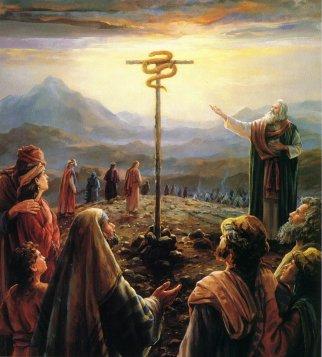
4 From Mount Hor they set out by the way to the Red Sea, to go around the land of Edom; and the people became impatient on the way. 5 And the people spoke against God and against Moses, "Why have you brought us up out of Egypt to die in the wilderness? For there is no food and no water, and we loathe this worthless food." 6 Then the LORD sent fiery serpents among the people, and they bit the people, so that many people of Israel died. 7 And the people came to Moses, and said, "We have sinned, for we have spoken against the LORD and against you; pray to the LORD, that he take away the serpents from us." So Moses prayed for the people. 8 And the LORD said to Moses, "Make a fiery serpent, and set it on a pole; and every one who is bitten, when he sees it, shall live." 9 So Moses made a bronze serpent, and set it on a pole; and if a serpent bit any man, he would look at the bronze serpent and live.

Numbers 21:4-9


14 And as Moses lifted up the serpent in the wilderness, so must the Son of man be lifted up, 15 that whoever believes in him may have eternal life." 16 For God so loved the world that he gave his only Son, that whoever believes in him should not perish but have eternal life.

John 3:14-16


After the people’s miraculous exodus from bondage in Egypt, their joy to turned to bitterness in the wilderness. They complained against God and Moses and blasphemed God’s gift, the bread from heaven. They suffered snakebites in punishment for their sins. The snakebites caused great pain, in many cases followed by death. This great suffering brought many of them to acknowledge their sin to Moses and ask his intercessory prayer that the serpents be removed. Now, God certainly could have simply removed the serpents and healed the people on the basis of their interior repentance. Instead, He provided through Moses a peculiar ritual, in which those who participated could “live”.

What can we say about this ritual?
  • It required a specific action on the part of the minister: Moses had to place a “fiery serpent” on a pole and make it accessible to the people.

  • The ritual bore a divine promise: God said that “every one who is bitten” would survive upon seeing the serpent.

  • It required a specific action on the part of the one desiring healing: he must look upon the serpent. In this, each person hoping to be healed needed to acknowledge his sins by gazing upon the representation of the consequence of their sins, the wages of which is death.

  • It was effective. The passage specifically tells us that people indeed were saved from death by obediently performing the outward action demanded by the rite.

  • It did not require perfect interior repentance. The outward action perhaps depended on at least some sort of repentance, but the 'bar' was set low, so to speak.

  • The snakes themselves, as well as the painful bites they caused, were not taken away. The people still had to suffer from painful but temporary consequences of their sins. Yet God, through the ritual, cancelled the fatal outcome of their punishment.

  • Healing was on God's terms, not the people's. They wanted their suffering taken away. Instead, God gave them life. They wanted their wishes granted simply by their request to Moses. Instead, God required a specific action that would require and manifest obedience on the part of the sinner.

Jesus, in the Gospel of John, relates this reality to Himself. In fact, the incident in the desert foreshadows the crucifixion of our Savior. The serpents were not sin, but they were sent by God because of sin, and to chastise, and to urge sinners to repentance. Jesus was not sin, but He was sent by His Father because of sin, and to call sinners to repentance. The serpents and their icon on the pole together brought conviction of sin and a means of rescue from its fatal consequence: natural death. The crucified Lord brought knowledge of sin and a means of rescue from its eternal spiritual consequence: eternal death.

21 For our sake he made him to be sin who knew no sin, so that in him we might become the righteousness of God.

2 Corinthians 5:21


Bible Q&A: According to the Bible account…
  • Who was healed… everyone who repented, or everyone who looked at the serpent?
    –Those who looked at the serpent.

  • Did anyone survive who did not look at the serpent?
    -We aren’t told.


The serpent on the pole prefigures the sacraments of the New Covenant, particularly Baptism. In Baptism, God has prescribed a simple ritual which He requires man to perform in order to obtain a supernatural promise: forgiveness of sins and a share in the very life of God.

38 And Peter said to them, "Repent, and be baptized every one of you in the name of Jesus Christ for the forgiveness of your sins; and you shall receive the gift of the Holy Spirit. 39 For the promise is to you and to your children and to all that are far off, every one whom the Lord our God calls to him."

Acts 2:38-39


Again God 'sets the bar low' in order to make His grace and salvation accessible to everyone, including us many who have difficulty repenting perfectly of our sins. God helps us to understand just how unmerited His forgiveness is, by attaching it as a divine promise to the simple human act of washing, but washing that is always received, never done for oneself. People desiring Baptism do not and can not baptize themselves.

The outward act of Baptism is so simple, so commonplace... yet so illustrative of the great supernatural reality taking place: the Spirit hovers over the water; water flows from the side of the Savior; God says "Let there be Light"... and the Light of Christ dawns upon the first day of a new creation more glorious than God's creation of the universe. All we need do is cooperate to the extent that God's grace has enabled our feeble will. If all we can do is set our eyes upon the cross, if all that time permits is the brief expression of faith of the thief on a cross, then God can save. But let us not put ourselves and our children in the category of those Israelites who did not gaze upon the serpent on the pole either out of pride, negligence, or disbelief. We can not safely presume they were saved.

The Bible plan -God's plan- is for us to preach and follow the sure and level path that God has provided, which begins with Baptism to ignite the lamp of our soul and set our course toward heaven. In this washing we are assured to receive the promise of eternal life through the waters of Baptism, to gaze upon our Savior through the lifegiving water flowing from His side:

he saved us, not because of deeds done by us in righteousness, but in virtue of his own mercy, by the washing of regeneration and renewal in the Holy Spirit...

Titus 3:5


17 The Spirit and the Bride say, "Come." And let him who hears say, "Come." And let him who is thirsty come, let him who desires take the water of life without price.

Revelation 22:17